
Hello, dear reader, and welcome back to another instalment of Horror Fiction Addiction!
In this post, I will explore the use, and importance of, location in horror fiction.
Location and setting in horror fiction are paramount because without a place for your story to occur, your characters would just be floating in… well, space. And that’s only effective if that’s what you intend!
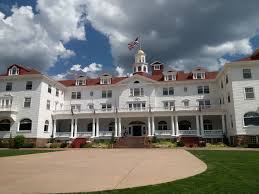
Let’s start with the most common location used in popular horror fiction, the haunted house. “In the case of these stories, the space itself IS the story. Think of the Overlook Hotel in The Shining, or Hill House in The Haunting.”[1] One reason as to why houses are such good locations for horror is that they are familiar to us, as most of us live in houses. Homes are safe-havens, where we come to relax and unwind, to shut out the atrocities of the world. So what if a threat is introduced to our safe-spaces? It makes it all the more terrifying. Sigmund Freud’s theory of ‘The Uncanny’ presents the notion that uncanny feelings are aroused when something familiar, such as a house, is presented as unfamiliar when there’s a great big monster with big pointy teeth in that house. “…the “uncanny” is that class of the terrifying which leads back to something long known to us, once very familiar.”[2] The idea that anyone (or anything) who wanted to get in, they theoretically could. This location has been used right back in Edgar Allen Poe’s day, and it only gets more intense as the years float by. Our houses are supposedly becoming safer with many technological devices, so the notion of someone being able to get in is frightening in itself, not to mention what they might do once they’re inside.
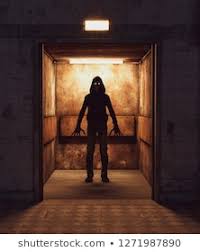
Now, to more unconventional settings. Now, the elevator is often part of the house setting, it can be found in stories such as The Shining with significant modern buildings, but it isn’t usually the sole setting. In the ‘Abduction Door’ by Christopher Golden, Golden has taken a space which can be quite unexciting and mundane for some or terrifying for others, due to the small space and the possibility of being stuck. Still, he has added a supernatural, and quite terrifying, element to it. When there is a child present in the lift, a door leading to a fleshy, human-eating bug habitat appears, and the child is snatched from their parent. The imagery of this world, “below the honeycomb of stolen children is another chamber, where horrible, spindly figures move back and forth to wide-mouthed ovens whose fire – when their doors are opened – turns the honeycomb prison a furious red.”[3] Isn’t as terrifying as the prospect of the burdening ethical dilemma the protagonist has to make. To save his child, he accidentally imprisons himself. To escape, he has to snatch 13 other children, or he is left in a corridor to starve with the other parents. What would you do?
I hope you enjoyed this horror and location blog post! Stay tuned for the fourth and final post, coming to you on the 3rd of April! Stay away from lifts!
References
[1] The Importance of Location in Horror, Luna Station Quarterly
[2] Sigmund Freud, ‘The Uncanny’, Art and Literature Vol. 14 (Penguin, 1990) pg. 340
[3] Golden, C, ‘The Abduction Door’, Morris, M, New Fears, (Titan Books, London, 2017) pg. 361
Bibliography
Golden, C, ‘The Abduction Door’, Morris, M, New Fears, (Titan Books, London, 2017)
Freud, S, ‘The Uncanny’, Art and Literature Vol. 14 (Penguin, 1990)
Luna Station Quarterly, The Importance of Location in Horror,
Date accessed: 17/03/20

